Monday, October 12, 2026

Agentic AI in Healthcare: Transforming Clinical Workflows and Patient Experiences

Healthcare professionals manage an enormous amount of information every day. From patient records and appointment schedules to clinical documentation and administrative requests, many tasks require time that could otherwise be spent supporting patients.

Agentic AI in Healthcare

Artificial intelligence is helping healthcare organizations address some of these challenges. While traditional AI applications often focus on prediction, classification, or information retrieval, agentic AI introduces another possibility: systems that can coordinate multiple steps toward a defined goal.

For example, an AI agent might help prepare a patient visit by gathering relevant information from authorized systems, identifying missing documentation, and creating a summary for a clinician to review.

These capabilities could improve operational efficiency and patient experiences. However, healthcare requires careful attention to privacy, safety, clinical responsibility, and regulatory obligations.

What Is Agentic AI in Healthcare?

Agentic AI refers to AI systems that can interpret a goal, determine appropriate steps, interact with approved tools, and work through a task within defined boundaries.

In healthcare, these systems may support administrative processes, information management, patient communication, and selected clinical workflows.

Consider a patient who needs to schedule a follow-up appointment. An AI agent could help identify available appointment slots, check relevant scheduling rules, prepare a reminder, and route exceptions to staff.

The system would need appropriate access to scheduling information and clear rules for handling conflicts or missing details.

Agentic AI does not replace the professional judgment of clinicians. Its role should be defined around tasks where automation can safely assist healthcare teams.

1. Reducing Administrative Work for Clinical Teams

Administrative work is a significant part of healthcare operations. Clinicians and support staff may spend time preparing documentation, gathering patient information, coordinating referrals, and managing follow-up activities.

Agentic AI can help coordinate some of these tasks.

For example, before a scheduled appointment, an agent could retrieve authorized information from the electronic health record, summarize relevant recent interactions, and identify missing forms. The clinician could review the summary before meeting the patient.

Another workflow might involve processing referral requests. An agent could check whether required documents are present and route incomplete requests to the appropriate team.

These applications can reduce repetitive information gathering, but the quality of the result depends on data accuracy, integration reliability, and appropriate human review.

2. Improving Patient Scheduling and Coordination

Scheduling involves more than finding an available time. Healthcare organizations must consider appointment types, provider availability, preparation instructions, cancellations, and patient preferences.

An AI agent can assist with routine scheduling workflows by checking approved availability, collecting necessary details, and helping patients understand their options.

For example, a patient who needs a routine follow-up could interact with an AI-powered scheduling assistant that presents suitable appointments and confirms the selected option according to the organization's rules.

More complex situations, such as urgent symptoms or conflicting clinical instructions, should be escalated rather than handled as ordinary scheduling requests.

Healthcare providers should also ensure that scheduling systems protect patient information and do not allow agents to modify appointments without the required authorization.

3. Supporting Clinical Documentation

Clinical documentation can be time-consuming, especially when professionals need to record information across several systems.

AI agents can support documentation workflows by organizing information, preparing draft summaries, and checking whether required fields appear to be missing.

For example, an agent could prepare a draft visit summary using clinician-approved notes and relevant patient information. A qualified healthcare professional would review the draft, correct errors, and approve it before it becomes part of the official record.

This distinction is important. A generated summary should not be treated as an authoritative clinical record until it has passed the required review and approval process.

Healthcare organizations should evaluate documentation systems for omissions, unsupported statements, incorrect terminology, and the risk of mixing information from different patients.

4. Connecting Electronic Health Records and Healthcare Systems

Healthcare information is often distributed across electronic health records, laboratory systems, pharmacy applications, scheduling platforms, and billing tools.

Agentic AI can help coordinate information retrieval and workflow execution across these systems when appropriate integrations are available.

For example, an agent assisting with referral coordination might verify that a referral has been received, check whether required documents are present, and notify staff when a step remains incomplete.

Standards such as HL7 and FHIR can support interoperability, although integration still depends on the capabilities and configuration of the individual systems.

Healthcare organizations should establish clear data-access rules and validate every action that affects patient records.

The agent should retrieve only the information required for its task and create appropriate audit records for important operations.

5. Enhancing Patient Communication

Patients frequently need answers to routine questions about appointment preparation, clinic procedures, follow-up instructions, and administrative policies.

AI-powered agents can help provide timely responses using approved healthcare information.

For instance, an agent might explain how to prepare for a scheduled appointment using instructions published by the clinic. It could also help a patient locate contact information or request an appointment change.

However, patient communication requires careful safeguards. The system should distinguish administrative questions from requests involving potentially urgent symptoms or clinical decisions.

It should not present unverified medical information as a diagnosis or substitute for professional care.

When a request falls outside the agent's approved scope, the system should direct the patient to an appropriate healthcare professional or emergency service, according to the organization's established protocols.

6. Assisting With Patient Follow-Ups

Follow-up activities can involve appointment reminders, requests for missing information, and coordination between healthcare teams.

An AI agent may help identify tasks that need attention and prepare reminders based on approved workflows.

For example, after a clinician documents a follow-up plan, an agent could help create a task for the responsible team and prepare an appointment reminder, subject to the required approvals.

Such workflows must respect patient communication preferences, consent requirements, privacy policies, and applicable regulations.

The agent should not independently change treatment plans or make clinical decisions beyond its authorized role.

7. Supporting Healthcare Operations and Resource Planning

Healthcare administrators need reliable information to manage workloads, staffing, equipment, and patient flow.

Agentic AI can help gather operational data, identify potential bottlenecks, and prepare reports for decision-makers.

For example, an agent could review appointment schedules and highlight patterns associated with repeated scheduling conflicts. It might also summarize bed-capacity reports or identify incomplete administrative tasks.

These outputs can help teams investigate operational problems, but recommendations should be reviewed in context.

Healthcare leaders must account for data quality, local procedures, and the risk of drawing misleading conclusions from incomplete information.

8. Privacy, Security, and Regulatory Considerations

Healthcare AI systems handle information that requires strong protection. Organizations must evaluate applicable privacy laws and healthcare regulations, including HIPAA where relevant.

Key safeguards include:

  • Role-based access controls and least-privilege permissions.

  • Encryption and secure data transmission.

  • Audit logs for information access and system actions.

  • Appropriate data retention and deletion policies.

  • Human approval for sensitive or consequential operations.

  • Security testing and incident-response procedures.

  • Clear policies for vendors, integrations, and third-party model providers.

Organizations should also assess prompt injection and other attacks that could manipulate an agent through malicious content in messages or documents.

Privacy and compliance cannot be achieved simply by selecting a particular AI model. They depend on the complete system, its deployment, contractual arrangements, access controls, and operating procedures.

9. Clinical Safety and Human Oversight

Healthcare decisions can directly affect patient well-being. For that reason, organizations must distinguish administrative automation from systems that influence clinical decisions.

AI agents should be tested using representative scenarios, including incomplete records, conflicting information, unusual requests, and system failures.

Healthcare professionals should determine which outputs require review and which actions must never occur without explicit authorization.

The organization should also monitor error rates, escalation frequency, user feedback, and potential safety incidents after deployment.

If a system supports a regulated clinical function, its intended use and applicable regulatory requirements should be assessed before launch.

10. How to Implement Agentic AI in Healthcare

Healthcare organizations should start with a narrow, well-defined workflow rather than attempting to automate multiple clinical processes at once.

First, identify a repetitive administrative problem and document the existing process. Next, review the data sources, integration requirements, privacy implications, and potential risks.

Build a pilot with clear boundaries, approved tools, and a human escalation path. Test the system using realistic scenarios and involve the staff who will use it.

Measure the results against a baseline. Useful indicators may include administrative processing time, incomplete requests, error rates, staff workload, and patient satisfaction.

Expand the solution only when it demonstrates reliable performance and meets the organization's safety and governance requirements.

Conclusion

Agentic AI has the potential to help healthcare organizations coordinate administrative tasks, improve information access, support documentation, and streamline patient communication.

Its success will depend on more than automation capabilities. Reliable integrations, accurate data, privacy protection, clinical oversight, and clearly defined responsibilities are essential.

Healthcare organizations should begin with practical use cases where the benefits can be measured and the risks managed. With a thoughtful implementation strategy, agentic AI can support healthcare professionals without replacing the expertise and judgment that patient care requires.

TOPS Infosolutions helps businesses explore AI-powered software development, intelligent automation, and system integrations tailored to their operational requirements.

Tuesday, February 28, 2023

Everything You Need to Know About Node.js for Backend Development


The digital world has grown in leaps and bounds in the past few years. Spurred by the pandemic, the physical world – in an unprecedented manner – made a shift to the digital world.

This, in turn, raised expectations in terms of operational efficiency among businesses. Today, businesses are adopting and adapting to technological advancements to keep up with the changing industrial landscape.

The challenge, however, lies in picking out the best tech stack. This is where the most popular and trusted modern application framework – Node.js – makes its entry.

Node.js development services are extremely popular as this framework is being used by a wide range of businesses such as Netflix, Twitter, etc. for their server-side application development.

StackOverflow’s 2022 Developer Survey shows that Node.js was chosen by 47 percent of its respondents and hence earned its position as the most popular web technology among web developers.

If you are wondering what Node js development services are and how they can add value to your business, read on to learn everything about Node.js!

What is Node.js?

In technical terms, Node.js is described as a single-threaded, open-source, cross-platform runtime environment that facilitates the development of server-side and networking applications that are fast and scalable.

In simpler terms, Node.js offers a balanced intersection of frontend and backend technologies. This means that it extends the capability of JavaScript to run on the server side of both web application architecture as well as serverless architecture.

If an analogy is to be drawn, Node.js is comparable to Java which also runs applications in its runtime. The ease of use and efficacy of Node.js is the reason for the boom in Node js development companies in the USA.

Node.js Frameworks / Approaches

Node.js is on its own an extremely powerful and versatile platform. However, several frameworks and approaches have also been developed to increase the efficiency of Node.js.

Here is a quick snapshot of these frameworks that contribute extensively to Node.js development services:

NestJS

NestJS is built on an abstraction of other Node.js frameworks such as Fastify and Express. This framework is extensible, versatile, and open-source and includes TypeScript, which is a subscript of the popular JavaScript. The abstraction makes this framework easier and faster for developers to learn and work on projects.

Modules, providers, and controllers form the foundation of the NestJS foundation. The first concept – Modules- is nothing but logical units of code put together. All applications need at least one root Module.

However, depending on the code organization, web developers may build more Modules on top of the code. The second component – providers – are abstractions of the code that can be injected at a certain stage as dependencies.

The third and last component – controllers – front end by taking in client requests, executing application logic, and responding.

Due to its ease of use and extensibility, NestJS is quite popular and offers a host of benefits. They are great for developing microservice architecture, lend a strict project structure, and enable a team of programmers to undertake a less bug-ridden development process.

ELECTRON

Electron combines the Node.js runtime with the Chromium rendering engine and facilitates the easy development of desktop applications on JavaScript. Furthermore, it also allows programmers to develop desktop applications in HTML5 and CSS, which are platform-agnostic web languages. Overall, it makes packaging and installation of these applications easier.

Electron is best suited for businesses that require desktop applications. Its framework allows speed up the development process and, therefore, it can be extremely helpful for a business that is looking for quick marketing of its new products.

DENO

The third framework – DENO – addresses the most critical aspect of the application – security, compatibility, and modules. DENO was introduced in 2018 by the creator of Node.js specifically to address the challenges that developers were facing.

The advantage that DENO offers is that the runtime executes in a sandbox safely isolated from the file systems. As a result, attackers are prevented from breaking out and securing access to the server the code is running on.

By allowing modules to be directly imported by a URL, DENO does away with the necessity for a centralized package management system. Also, DENO supports TypeScript which enhances browser compatibility – thus earning its popularity among web developers.

Why Use Node.js?

The popularity that Node.js and the surge in demand for Node.js development services are because of the ease it offers and its applicability in different types of use cases.

Here are a few reasons why you should use Node.js:

Applications are Lightweight and Fast

Node.js is particularly useful when it comes to building small, fast and scalable applications. Collaboration tools and instant messaging apps are the best examples. When coupled with fast synchronization abilities, Node.js can be useful for event-based applications too.

Flexible and Useful in Building Serverless and Microservice Architecture

Node.js is an extremely flexible framework that allows it to be used for the development of serverless and microservice architecture.

Both design styles are extremely popular because they help in saving resources and efficiently manage application lifecycles.

This is nudging more and more businesses across the globe to engage in Node.js development services.

Internet of Things

Node.js is efficient at handling multiple connections and hence works well with IoT. Node.js can successfully handle small messages that are relayed over multiple devices and hence it is very efficient when applied to IoT.

Processing Audio or Video

Another area where Node.js finds much application is processing audio and video. This is because Node.js can much more effectively handle asynchronous input and output. For instance, you can easily and quickly configure a streaming setup using Node.js.

Minimal Ramp Up Times

Because Node.js is built on common web languages, it is very easy to use and hence cuts down on ramp-up time and engineering resources, significantly. Cost efficiency is one of the major reasons for companies to engage in Node js development services.

Integration with C++ Code

As the Node.js runtime is built on a C++ server, it can seamlessly integrate with C++ libraries. As a result, Node.js quickly transmits data between the application code and C++.

How is Node.js Different from Other Backend Technologies?

Each framework is distinct and designed for a specific purpose. While the differences may not be blatantly apparent, they do exist.

Here is a quick comparison of Node.js with Java and Python.

Node.js Vs Java

Node.js and Java are often compared because both run their programs within their own runtime environment. However, there is a clear distinction between the two.

Java has a syntax similar to C++ and is an object-oriented programming language. This makes Java-heavy to use and costly to develop.

Node.js on the other hand is lightweight and based on non-compiled programming languages such as JavaScript.

Node.js is preferred for I/O applications for this reason. Furthermore, its efficiency in handling server-side HTTP requests is another reason that adds to its popularity.

Node.js Vs Python

Python is also widely popular among developers because of its simple syntax and ease of use. However, Python is more comparable to Java in terms of its object-oriented language.

While it is interpreted like JavaScript, its programs are seen to consume a sizeable volume of computing resources.

When Not to Use Node.js?

Node.js is not recommended for application development for fintech. The reason for this is the specifics of work with the floating decimal point that can lead to an accumulation of errors.

Similarly, it is not the best choice when it comes to working with heavily loaded threads that involve a CPU.

Trends in Node.js in 2023 and Beyond

Gauging by the popularity that Node.js enjoys currently, it would be safe to say that it will see much more adoption and integration as the world of business transitions into a more web-driven world.

However, some other Node.js frameworks will also see greater adoption in the coming years.

Frameworks such as Deno are expected to see more adoption due to their modularity and extensibility.

Similarly, Bun, which is a new runtime for JavaScript and TypeScript holds much potential as it offers higher performance and speed.

Amplify, which is a full-stack framework by AWS, and Remix – a newer web technology – is expected to trend in the coming years.

Need expert advice? Reach out to the experts at Tops Infosolutions!

Choose Our Custom Development Services for Your Future Project

If you are looking for hyper-efficient Node.js development services – Tops Infosolutions is the name, you are looking for.

We are pioneers in Node.js development and service clients across the globe. From developing business applications based on MEAN stack to delivering full-stack JavaScript frameworks, Tops offers a range of scalable solutions.

To know more, you can write to us at contact@topsinfosolutions.com or call us at +1 408 400 3737.

Originally published at https://www.topsinfosolutions.com/ on Jan 5, 2023

Monday, February 27, 2023

Introductory Guide to Understanding ChatGpt as a Business Advantage

ChatGpt is the first AI technology that has been adopted by a massive number of users worldwide. It is an advanced AI bot launched by OpenAI in November 2022 using the Gp-3 family of large language models. It uses natural language processing (NLP) and a vast knowledge database to interact in a more human and conversational manner. As a result, the AI can comprehend customer needs and respond to their queries in a personal way. This shows ChatGpt’s capability to enhance customer interaction in 2023 and the years to come and help add a competitive advantage to businesses. 

Different businesses in e-commerce, finance, education, retail, technology, healthcare and other sectors can leverage the abilities of ChatGpt. The AI tool can be used as a user-friendly and intuitive standalone application or integrated into your industry apps to improve functionality and features. This article explains the benefits and capabilities of ChatGpt for different industries in more detail. Get valuable insights into AI to benefit your business.  

Read More: https://www.topsinfosolutions.com/blog/introductory-guide-to-understanding-chatgpt-as-a-business-advantage/


Friday, February 24, 2023

How Emotional Intelligence Can Help Business Analysts to Excel

Although technical and analytical skills are the key to helping you qualify as a business analyst, emotional intelligence is equally important to excel in the position. Business analysts have to work with stakeholders from different departments and backgrounds. Effective interpersonal and communication skills help them establish long-term relationships. However, a lack of empathy to understand situations can make it difficult to build trust, and that’s where emotional intelligence comes into the picture. 

The ability to perceive, interpret, and comprehend others' emotions and express your emotions in a controlled manner helps solve complex business issues. It helps translate technical jargon into business language that stakeholders can understand, leading to effective communication and resolution of conflicts. It also enables you to adapt to changes in a dynamic business environment. While this is just a glimpse of how important emotional intelligence is for a business analyst, this article explains it beautifully with more details and practical situations that can help you understand the subject in more detail. 

Read Blog: https://www.topsinfosolutions.com/blog/why-emotional-intelligence-matters-for-business-analysts/


Wednesday, December 7, 2022

Node.js vs. React.js: Which to Choose for Your App Development?


Node.js and React.js belong to JavaScript, yet they are different. Node.js is a back-end framework that enables developers to create dynamic web page content using command-line tools and server-side scripting. On the other side, React.js is applied to build the user interface of an app. To develop a mobile app, it is essential to learn about both options in detail to make the best decision. 

As a leading react.js and node.js development services provider, we have discussed both technologies in detail below to help you determine which one you should choose for your project.

Primary Features of Node.js Development

Single-Threaded

Node.js is a lightweight framework that is more scalable than other counterparts as it runs a single-threaded process with event loops. The technology is beneficial in managing several requests compared to traditional servers such as Apache HTTP Server. 

Open Source

It is available as an open-source option for code, so it is readily available to use free of cost.

Improved Performance 

If you want to build a mobile app with better performance, Node.js is the best option. It helps the developers complete non-blocking methods executed asynchronously, increasing your app's performance. 

Scalability

With an excellent capability to scale up the app performance horizontally and vertically, it becomes a powerful solution for app development. 

Zero Buffering 

Node. js-based mobile apps display performance in blocks due to their callback function. Thus, the users receive the data quickly without waiting for the operation to finish. As it reduces the processing time, there is no buffer on data. 

Primary Features of React.js Development 

Easy Maintenance 

Thanks to its library, React.js is easy to maintain, with the ability to reuse any critical system elements. It also provides resolutions during the updating of its framework. 

Extensions 

React.js offers extensions that enable users to build a complete app architecture. It is famous for building cross-platform mobile apps. 

Enhanced Performance 

With the Virtual Document Object Model (DOM), React.js can improve the performance of any mobile app. 

Stability 

The technology provides written code that is highly stable for its usage in the downward flow of data. 

JSX 

This is one of the best features represented as a markup language resembling HTML. 

Event Handling 

This technology can apply its event system in compliance with the W3C object model. Specially made event examples will shield all native events, so it combines the latter with a cross-browser interface. 


Comparison Between Node.js and React.js


Node.js vs. React.js: Application Examples 

React and many businesses around the world use Node.js development services. Many big-name apps, including Airbnb, Netflix, PayPal, and Uber have been developed using these technologies. Sometimes, both are used in combination to create online apps that enable real-time updates.

React.js

If you are looking to build a single-page app, React is a suitable option. However, it may not cater to your needs if you want to develop an extensive and sophisticated application. As the technology can only help you with the user interface, you need to combine it with another technology for developing complicated applications. 

Node.js 

This technology is a core library written in JavaScript and is a bundled compilation of Google’s V8 JavaScript engine. With benefits such as a powerful ecosystem and asynchronous, non-blocking I/O, you can utilize Node.js to build different data streaming functionalities for mobile apps. For example, you can manage uploaded files while they are uploading. And when data arrives through a stream, it may be managed online without interruption. If you want to develop a real-time application such as a chat room, it requires a high traffic capacity, a lightweight design, and a substantial data flow. You can use Node.js development services with a JS framework like Express to build such applications. 


React.js and Node.js have their own advantages in software development. Both of these frameworks have backups from huge communities.  


Key Takeaways

  • Opt for node.js development services to build an assortment of tasks as it provides scalability, speed, and better performance for app development. 

  • Opt for React.js development services to develop lightweight web and mobile apps as they can be run on the server side with virtual DOM, which is a lightweight JavaScript representation. 

  • Both frameworks have big developer community support, so they are beneficial to use for specific business requirements. 

  • Opt for Node.js development service for the back-end of software development as Netflix achieved and use React for the front-end. 

Choose Us for Custom Development Services for Your App Development 

TOPS Infosolutions is a leading software development and consulting company that combines technical expertise and business intelligence to build tailored and beautiful apps specific to your organizational needs. We have extended our services to over 250 clients in more than 20 countries. Our team of skilled developers has in-depth experience developing apps for various industries and can build custom functionalities for your app. We have the resources, skills, and workforce to handle projects efficiently and cost-effectively while meeting your deadlines.    


If you are looking for custom development services, we will help you choose the ideal framework and accomplish the project successfully. Contact us to learn more about our services. 


Thursday, October 13, 2022

Migrate from AngularJS to a Newer Technology While Retaining the Backend


If you have been following our blogs for a while, then you know we are a full-stack development company. That is, you come in with an idea and walk out with the app(s). We are an end-to-end solution provider for various industry verticals and work on every aspect of application development from conception to lifecycle support. However, not everyone coming to us has requirements this simple. For example, lately we’ve been hitting too many inquiries from people looking to migrate their application base from AngularJS to a newer technology. With AngularJS entering end of support soon and Google not providing any official upgrade path, there are more question unanswered.

To be frank, migrating an app from one development technology to another even with the same programming language and similar architecture is a complex task and at times requires rewriting the entire code from scratch. Which begs the question, “Do I need to rewrite the backend code too?”. The short answer is a big NO. No, you don’t have to. For the longer answer and little background into ‘why’, keep reading.

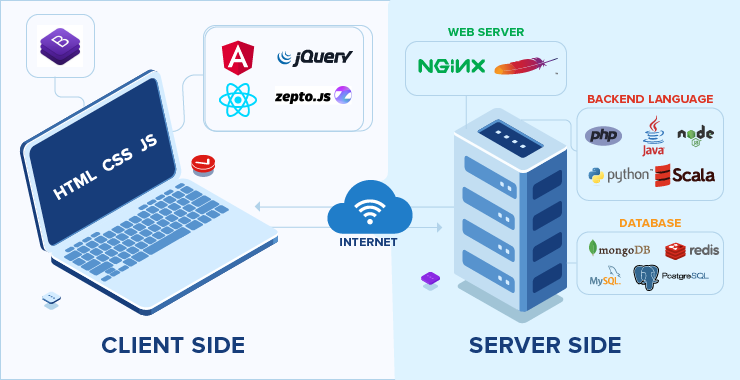
Frontend and Backend Frameworks

Frontend and backend frameworks

AngularJS is a frontend framework and if you ask us to replace it with a newer technology, as a JavaScript developer, I would be least concerned how your backend looks like. The same goes when it comes to replacing the backend technology. If you are using Laravel, I don’t care whether you’re using React or any other front-end technology. People are coming to us with that kind of question. They are apprehensive about the whole cost involving rewriting backend and frontend. With this blog I am going to clear many misconceptions about the development technology migrations from AngularJS in context of JavaScript realm.

API Calls: How Frontend talks to Backend?

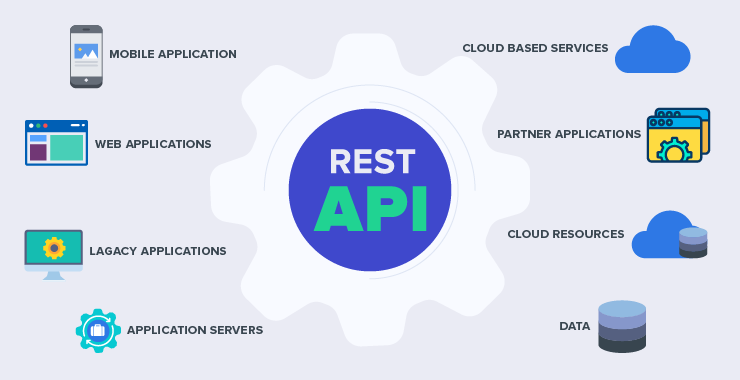
If you’ve been associated with IT operation in any way, you must have heard of APIs a lot lately. APIs let your websites and apps access third party services such NASDAQ, Weather.com, Facebook, Google etc. APIs. If we look at the definition of API, it allows two pieces of software to communicate. Software engineering treats frontend and backend as two pieces of software that builds an application. An API itself is a piece of code which is embedded inside frontend code. The API code has a pointer to the location of backend service on a server, which frontend wants to seek in response to a user’s request over a given protocol. One of the most common protocols over which API calls are made is HTTP(S). Rest APIs or RESTful APIs are the reason for the existence of modern web apps.

REST APIs are the Backbone of Modern Web

When we write a piece of JavaScript code, it has both stateful and stateless parts. For example, AngularJS applications have code specific to AngularJS which other frameworks won’t understand and JavaScript code which is standard across the board.

REST APIs

REST APIs are stateless that is they don’t have any dependency on a particular framework or technology. These APIs are good to go as long as they can establish a HTTP connection between the two ends. With REST APIs, it doesn’t matter the backend or frontend since they communicate over stateless REST APIs in HTTP. At least, this is the ideal case.

So when your app or website has to seek a service for example weather information, it can make an API calls to its backend or a third party service like Weather.com. The frontend’s job is to show information to the user, it doesn’t matter where the information came from. But in JavaScript there is more to server technology, than facilitate the communication between the two ends.

Problems: JavaScript, SSR and Non-Node.js Backends

When you are migrating your application from AngularJS to React, Vue.js or Angular or any other frontend framework, you don’t have to worry whether your backend is Node.js or not because ultimately, the frontend is seeking certain services to fulfil users’ requests. Your business logic is smarter enough to trigger right API calls at the right time.

However, when we are talking about JavaScript development tools other than AngularJS such as Vue.js and React, we enter the SSR-dilemma. If you know every modern frontend JavaScript tool has a first class support for server-side rendering (SSR). Developers prefer SSR for improved performance and SEO benefits. For example, while Laravel doesn’t recommend a particular JavaScript or CSS pre-processors, it provides a starting point for using Bootstrap and Vue.js. Until Vue 2.5, it did not support server-side rendering support to non-Node.js environments including those around PHP, Python, Ruby etc.

Vue.js applications require certain Node.js APIs to run correctly. If your application uses those specific APIs, then either the application or the SSR code will break. To bring SSR support in Vue 2.5, Vue.js community made some major changes: including a block that spawns a JavaScript sandbox from the server to generate an output, which made the server renderer “environment agnostic”.

Upgrade your AngularJS Application with TOPS Infosolutions

Long-term support for AngularJS will conclude in mid-2021, which will expose your AngularJS application to security threats and zero-day vulnerabilities, limit its community, and deprive it from modern features. TOPS has the adequate resources to make the necessary measures to upgrade your Angular application while retaining your backend. We have an experienced team of JavaScript developers, which makes the upgradation a hassle-free, smooth transition.

Originally published at https://www.topsinfosolutions.com/ on Jan 10, 2020